Fes Medina Guide: Navigate the World’s Oldest Car-Free City
Fes el-Bali is the world’s largest car-free urban area — over 9,000 alleyways, no street names, no cars, no motorcycles, and an almost complete absence of logical grid planning. It has been functioning as a living city for more than 1,200 years.
Quick Answer: Fes el-Bali medina is navigated on foot using two main arterial streets (Talaa Kebira and Talaa Seghira) as orientation anchors. Google Maps is unreliable. The best offline alternative is Maps.me. You will get lost — plan for it, and use the Blue Gate (Bab Boujeloud) as your reset point.
Getting lost in Fes is not a failure. It is the experience. But arriving with practical orientation tools transforms the difference between a frustrating afternoon and one of the most memorable days of your life.
This guide covers everything: how the medina is structured, the two main navigation routes, the key neighborhoods, self-guided walking itineraries, photography tips, and exactly how to handle the scam situations you will encounter.
Understanding the Structure of Fes el-Bali
Before you enter the medina, a three-minute overview of how it is physically organized will save you enormous confusion inside.
The Basic Geography
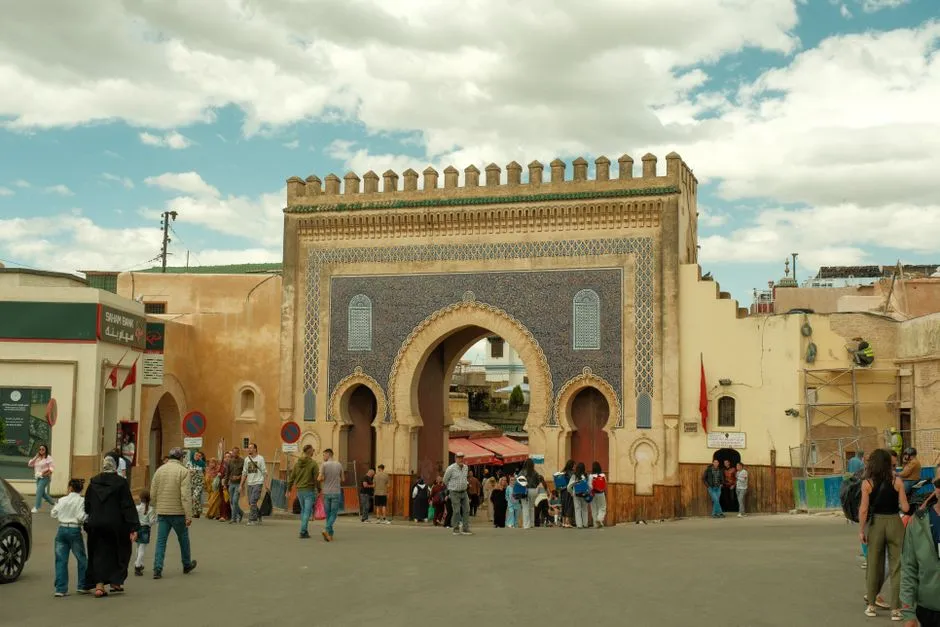
Fes el-Bali is built on two hillsides that slope down toward the Oued Fes river valley at the center. The Blue Gate (Bab Boujeloud) sits at the western entrance, elevated above the medina. Most visitors enter here and descend into the city.
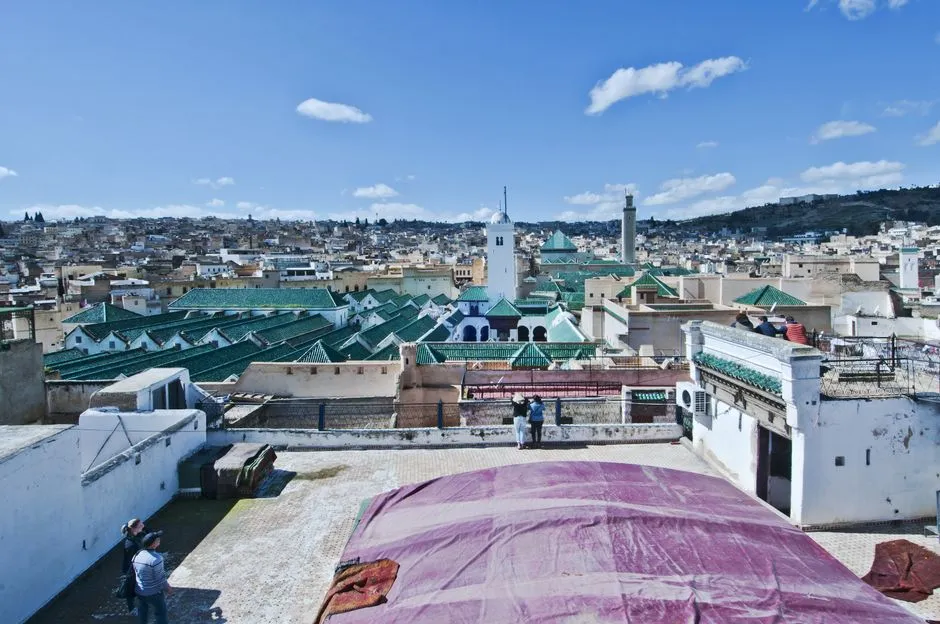
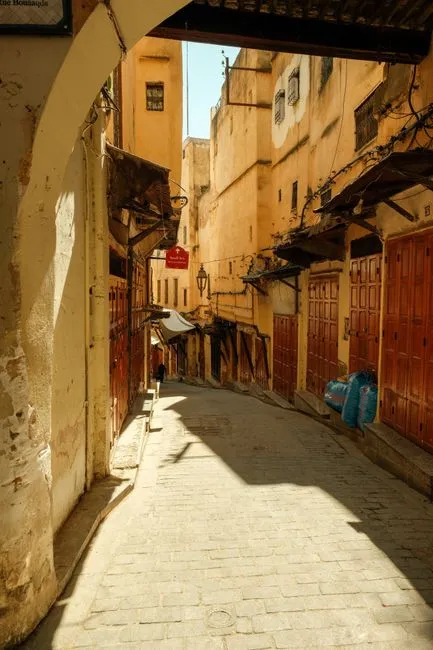
The UNESCO World Heritage Site covers approximately 280 hectares — roughly the size of a small European city center — but entirely compressed into narrow, winding, often roofed alleyways (derbs) that can be as narrow as 60 centimeters.
The Two Main Streets
Everything in Fes el-Bali navigation comes back to two streets:
Talaa Kebira (The Big Hill / Upper Street): The widest and most commercial street in the medina. It runs roughly northwest-to-southeast from Bab Boujeloud down to the Karaouine Mosque area. This is where most shops, food stalls, spice merchants, and tourist-oriented businesses are concentrated. If you are lost, finding Talaa Kebira and following it will eventually bring you to a major landmark.
Talaa Seghira (The Small Hill / Lower Street): Runs parallel to Talaa Kebira, slightly lower on the hillside. It is narrower, less commercial, and more residential. More authentic in atmosphere but harder to use for orientation if you are unfamiliar with the area.
Rule of thumb: Always begin your medina walks from Bab Boujeloud. Stand at the gate, facing into the medina. Talaa Kebira goes straight ahead and slightly left. Talaa Seghira goes straight ahead and slightly right.
Navigation: How to Actually Find Your Way
Why Google Maps Fails in Fes
Google Maps has two problems inside Fes el-Bali. First, the satellite imagery of the older medina sections is incomplete or outdated — the roofed derbs (covered alleyways) do not appear in aerial views. Second, GPS signal bouncing between close stone walls causes significant positioning errors. The app will show you as moving when you are standing still, or place you on a parallel street.
Do not rely on it for turn-by-turn navigation inside the medina.
What to Use Instead
Maps.me (Recommended): Download the Morocco map on Maps.me before entering the medina. This app uses OpenStreetMap data, which has much more detailed coverage of Fes el-Bali’s small alleyways than Google Maps. It is not perfect, but it is significantly more reliable for walking navigation.
Organic Discovery (The Honest Approach): The medina has directional signage at most major intersections, pointing to key landmarks: Tanneries → | Karaouine → | Bab Boujeloud ←. Learning to read these signs and combining them with the two-artery orientation system is sufficient for most navigation needs.
Bab Boujeloud as Reset Point: When genuinely lost, stop. Ask any shopkeeper “Bab Boujeloud?” and point questioningly. Everyone knows the Blue Gate. They will point you in the right direction. You may walk 5–15 minutes to get back there, but from Bab Boujeloud you can reorient and start fresh.
The Main Neighborhoods
Fes el-Bali contains several distinct quarters, each with its own character.
Andalusian Quarter (Eastern Bank)
The less-visited side of the medina, separated from the main western bank by the Oued Fes river. Founded in the 9th century by Andalusian refugees fleeing Córdoba, this quarter is notably quieter and more residential. Few tour groups reach here. Architecture is less ornate than the western bank but the atmosphere is more genuinely local.
Karaouine Quarter (Central)
The spiritual and academic heart of the medina, centered on the Karaouine Mosque and University — considered one of the oldest continuously operating universities in the world, founded in 859 AD. Non-Muslims cannot enter the mosque but can view its decorated entrance gates. The Al-Attarine Madrasa and the Attarine Souk (spice market) are located directly adjacent.
Tanneries Quarter (Northeast)
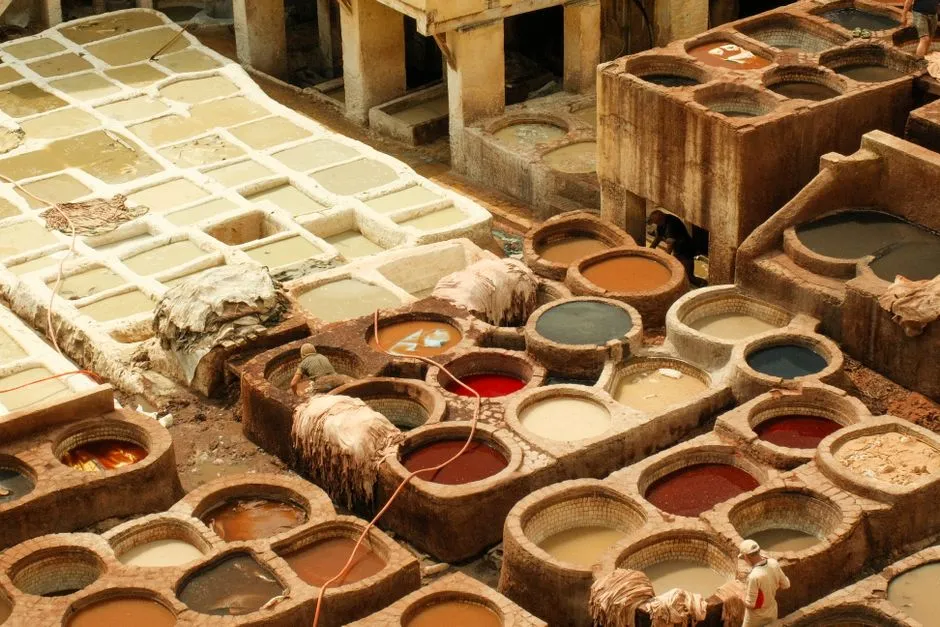
A distinct working-class neighborhood built around the three tanneries. The smell becomes noticeable several streets before you arrive. The architecture is more industrial — raw stone walls, flat rooftops used for leather drying, and the distinctive dyeing pits visible from the surrounding terraces. See our dedicated Chouara Tannery guide for full details.
Andalusian Bank vs. Western Bank
Most visitors spend their entire time on the western bank (Talaa Kebira side). The eastern Andalusian bank requires crossing one of several small bridges over the Oued Fes and receives far fewer visitors — making it worth an hour of exploration on your second day.
Self-Guided Walking Routes
Route 1: The Essential Half-Day (3–4 hours)
Best for: First-time visitors with limited time.
Starting point: Bab Boujeloud (Blue Gate)
- Bou Inania Madrasa — Begin with the best Marinid architecture in the medina. Located just inside Bab Boujeloud on Talaa Kebira. Entry: 70 MAD.
- Talaa Kebira walk — Continue south down the main artery. Stop at spice shops, watch artisans in open workshops.
- Chouara Tanneries — Follow signage for approximately 20 minutes from Bab Boujeloud. View from leather shop terraces (see tannery guide).
- Al-Attarine Madrasa — Short walk from the tanneries, next to the Karaouine Mosque entrance. Entry: 20 MAD.
- Attarine Souk — Browse the spice and craft market immediately surrounding the madrasa.
- Return via Talaa Seghira — Take the parallel lower street back to Bab Boujeloud for a different perspective.
Route 2: The Full-Day Deep Dive (5–7 hours)
Best for: Second or third visit; travelers with a real interest in the medina’s depth.
Add to Route 1:
- Cross to the Andalusian Quarter via the Andalusian Bridge
- Visit the Andalusian Mosque exterior and the quieter residential streets around it
- Explore the Mellah (former Jewish quarter) near Bab Semmarin — different architectural language from the rest of the medina
- Find the Nejjarine Museum of Wooden Arts (housed in a restored 18th-century caravanserai) — one of the best small museums in Morocco
Self-Guided vs. Guided: Which is Right for You?
This is a genuine question worth thinking through before you arrive, because the answer is not the same for everyone.
The Case for a Licensed Guide (First Day)
Fes el-Bali is legitimately confusing on a first visit. A licensed guide does several things that no map can replicate:
- Unlocks context: The history of specific buildings, the significance of particular architectural details, the identity of artisan crafts you are watching.
- Manages the social dynamics: A licensed guide can navigate the shop interactions, the tannery terrace system, and the tout encounters without you having to repeatedly engage with them.
- Efficient routing: A good guide will show you more of the medina’s significant sites in half a day than most independent visitors cover in two days.
Cost: Expect to pay 300–500 MAD (~$30–50 USD) for a half-day private licensed guide. Book through your Riad — they vet their contacts and their reputation depends on your satisfaction.
The Case for Independent Exploration (Day Two)
After one guided day, your orientation will be dramatically better. You will know the two main streets, the major landmarks, and how the tannery system works. Day two is where independent exploration becomes genuinely enjoyable rather than confusing.
The hybrid approach works best for most travelers: Hire a guide for your first morning (3–4 hours, covering the essentials), then spend your afternoon and the next day wandering independently.
Scams and Fake Guides: The Honest Guide
The medina around Bab Boujeloud and the approach to the tanneries has a concentration of informal touts operating a system that catches many first-time visitors. Understanding it removes its power.
The Standard Script
Near Bab Boujeloud, you will be approached by men (usually young, often speaking good French and English) with variations of:
“Where are you going? The tanneries? They are closed today / moved to a different location / difficult to find. I will show you.”
None of these claims are reliably true. The tanneries are at the same location they have been for 1,000 years. They close on Fridays for prayer but are otherwise open during normal daylight hours.
How to respond: “Thank you, I have a map.” Say it once, keep walking. Do not stop, do not engage in a conversation about whether your map is correct. Engagement invites persistence.
The Unsolicited Guide
Someone falls into step beside you and begins talking, pointing things out, offering historical information. After 10–15 minutes, they ask for payment.
Prevention: If you did not agree to a guide before walking, you do not owe payment. A clear “No thank you” when the situation begins is your most effective tool.
The “Friend” Who Knows a Shop
Someone befriends you on a street, invites you for tea, introduces you to “their cousin’s” shop — where prices are extremely high and pressure to buy is intense.
Reality: This is a common setup throughout Morocco’s tourist medinas. Enjoy a genuine conversation if you encounter one, but treat any guided shopping suggestion with scepticism.
Photography in Fes el-Bali
Fes el-Bali is one of the most photogenic places in North Africa. A few practical notes:
Best Locations
Blue Gate (Bab Boujeloud): Best photographed from the outside (from Place Batha) in mid-morning light. The blue tiles face west and catch warm morning light well.
Chouara Tanneries: Best between 9–11 AM when colors are most vivid and light hits the pits from the east. Detailed photography notes in our tannery guide.
Talaa Kebira: The street itself, particularly the covered sections with shafts of light falling through gaps in the overhead structures, is excellent material. Midday creates dramatic contrast.
Rooftop cafés: Several cafés along the medina’s main routes have rooftop terraces with panoramic views. Order a mint tea and take your time — these are some of the best overview shots of the medina.
Borj Nord viewpoint: The fortress on the hill above the medina gives the best aerial overview of the entire Fes el-Bali. Best in the golden hour before sunset.
Photographing People
Ask before photographing individuals, particularly in craft workshops, the tanneries, and the souks. Most people will agree with a smile; some will prefer privacy. A small tip is appropriate when someone has actively posed or cooperated.
Street photography (incidental, non-posed) is generally accepted, but exercise judgment — photographing women in conservative dress without consent is disrespectful.
Equipment
A standard or wide lens (24–35mm equivalent) is more useful in the medina than telephoto. Alleys are narrow and distances are short. A small mirrorless camera or even a modern smartphone is less conspicuous and easier to handle in tight spaces than a large DSLR with a zoom lens.
Cultural Etiquette
Fes is Morocco’s most religiously conservative major city. A few practical guidelines:
Dress: Both men and women benefit from covering shoulders and knees in the medina. Women who cover their hair (a lightweight scarf) will find they attract significantly less unsolicited attention.
Mosques: Virtually all mosques in Fes el-Bali are closed to non-Muslims. Do not attempt to enter, and be respectful when photographing mosque entrances and courtyards.
Ramadan: If visiting during Ramadan, be aware that many food stalls and some shops operate on altered hours or remain closed until iftar (the evening meal). The medina takes on a particularly atmospheric quality after sunset during this period.
Prayer times: Five times daily, the call to prayer signals a brief pause in commerce in many parts of the medina. This is normal and respectful — plan around it rather than against it.
Practical Information
Entry to Fes el-Bali: Free — there are no gates or tickets required to enter the medina.
Getting to Bab Boujeloud: From the Ville Nouvelle (New City), take a petit taxi (15–25 MAD, always request the meter) and ask for “Bab Boujeloud” or “Place Batha.” The Blue Gate is the universally understood landmark.
Safety: Fes el-Bali is safe for tourists by any reasonable standard. The primary annoyances are low-level hustle (described above) rather than any physical threat. Standard urban awareness applies.
Toilets: Public toilets exist near the major landmarks (Bab Boujeloud, Bou Inania, the tanneries) and are usually charged 2–5 MAD. Many café and restaurant terraces allow non-customers to use facilities if you order a drink.
Water: Do not drink tap water. Carry a water bottle. Bottled water is available throughout the medina (approximately 5 MAD for 1.5 liters).
Best time of day: Start early (by 9 AM) to beat the tour groups, which typically arrive between 10 AM and noon. Late afternoon (4–6 PM) offers beautiful light and a local atmosphere as residents return home.
Frequently Asked Questions
Is it safe to explore Fes medina alone?
Yes. Fes el-Bali is safe for solo travelers of all backgrounds. The primary challenges are navigational and social (touts and shop pressure) rather than physical safety. Solo female travelers will find a headscarf and confident body language (walking with purpose, not making prolonged eye contact with touts) significantly reduces unwanted attention.
How long does it take to walk through the medina?
There is no single "through" route — the medina is a network, not a corridor. Walking Talaa Kebira from Bab Boujeloud to the Karaouine Mosque area takes approximately 20–25 minutes at a steady pace without stops. A half-day (3–4 hours) covers the main sights comfortably. A full day lets you explore secondary neighborhoods and the Andalusian quarter.
Can I use Google Maps in the medina?
Not reliably. GPS positioning is inaccurate in the narrow covered alleys, and Google's mapping data is incomplete for many sections. Download Maps.me with the Morocco offline map as a more reliable alternative. The medina's directional signage (in Arabic and French) is also genuinely useful.
Do I need a guide for the medina?
Not strictly, but a licensed guide for your first half-day is genuinely valuable. The context they provide about architecture, history, and craft traditions transforms the experience. After one guided session you will have the orientation to explore independently. Expect to pay 300–500 MAD for a half-day private guide, booked through your Riad.
What are the must-see spots in Fes el-Bali?
The Bou Inania Madrasa (the finest Marinid interior in Morocco, 70 MAD entry), the Chouara Tanneries (viewed from leather shop terraces, technically free), and the Al-Attarine Madrasa (20 MAD) are the three essential stops. The Andalusian quarter is worth a visit if you have more than one day.
Is photography allowed in Fes medina?
Yes, in public spaces and from all the major viewing terraces. Ask permission before photographing individuals in workshops or the souks. Mosques and their interiors cannot be photographed. The major madrasas allow photography with your entry ticket.
Conclusion
Fes el-Bali rewards people who arrive prepared and patient. The medina will disorient you on the first morning — plan for it. Use Talaa Kebira and Bab Boujeloud as your anchors. Learn the signage system. Get a licensed guide for your first session if you want to hit the ground running.
By your second day, the streets that seemed like chaos will reveal themselves as a logical, human-scaled city that has worked the same way for twelve centuries. That shift in perception — from overwhelming to comprehensible — is one of the most satisfying travel experiences Morocco offers.
For the complete overview of what to do and where to stay in Fes, return to our main Fes Travel Guide.